

Tea Bags vs Loose Leaf: What Actually Differs
Table of Contents
- What Is Loose Leaf Tea and What Goes Into a Tea Bag?
- Flavor, Aroma, and Caffeine: The Real Difference Between Tea Bags and Loose Leaf
- Tea Bag Material Health Concerns: Microplastics and What to Avoid
- Loose Leaf Tea Brewing Time and Water Temperature Explained
- How to Brew Loose Leaf Tea Without an Infuser
- Cost Per Cup and Sustainability: Which Choice Adds Up?
- Frequently Asked Questions
Last Updated: September 23, 2026
What Is Loose Leaf Tea and What Goes Into a Tea Bag?
The tea bags vs loose leaf difference comes down to one thing: leaf size. Loose leaf tea is whole or partially broken leaves that unfurl freely in water. Tea bags typically hold fannings or dust, the tiny particles left over after premium leaves are sorted out.
That size gap shapes everything else, including flavor, caffeine release, and cost per cup. At Sunshinescoffee, we source loose-leaf blends precisely because whole leaves hold their aroma far longer on the shelf.
Loose leaf tea is tea made from whole, unbroken leaves that steep freely in water without a paper barrier. The leaves expand, or unfurl, as they absorb hot water. That expansion is what releases the full range of oils and compounds that create complex flavor.
Whole leaf grades sit at the top of the sorting chain. Below them come broken grades, then fannings, then tea dust. Each step down means smaller particles, faster extraction, and less nuance in the cup.
Whole Leaf, Fannings, and Tea Dust: Why Grade Matters
Grade describes leaf size, not quality directly, but the two travel together. Whole leaves keep their essential oils locked inside until they hit hot water. Fannings and dust expose far more surface area, so they release tannins quickly and turn bitter if you blink.
Here's how the grades stack up:
| Grade | Leaf Size | Flavor Release | Typical Use |
|---|---|---|---|
| Whole leaf | Intact leaves | Slow, layered | Loose leaf brewing |
| Broken | Torn pieces | Medium-fast | Mid-tier bags |
| Fannings | Small fragments | Fast, flat | Standard tea bags |
| Dust | Powder-fine | Instant, harsh | Cheap commodity bags |
Commodity tea almost always means dust or fannings. The siftings left after processing get swept into bags because they steep in seconds, which suits mass production. The trade-off is a cup that tastes the same every time, and not in a good way.
Flavor, Aroma, and Caffeine: The Real Difference Between Tea Bags and Loose Leaf
In the tea bags vs loose leaf comparison, flavor and aroma separate the two formats more than anything else, and the reason is mechanical, not mystical. Whole leaves hold volatile aromatic oils, compounds like linalool and geraniol in oolong, or hexenal in fresh green tea, inside intact cell structures. Those oils evaporate once a leaf is crushed into dust. That's why a loose leaf infusion often tastes brighter and more layered than a bagged version of the same tea.
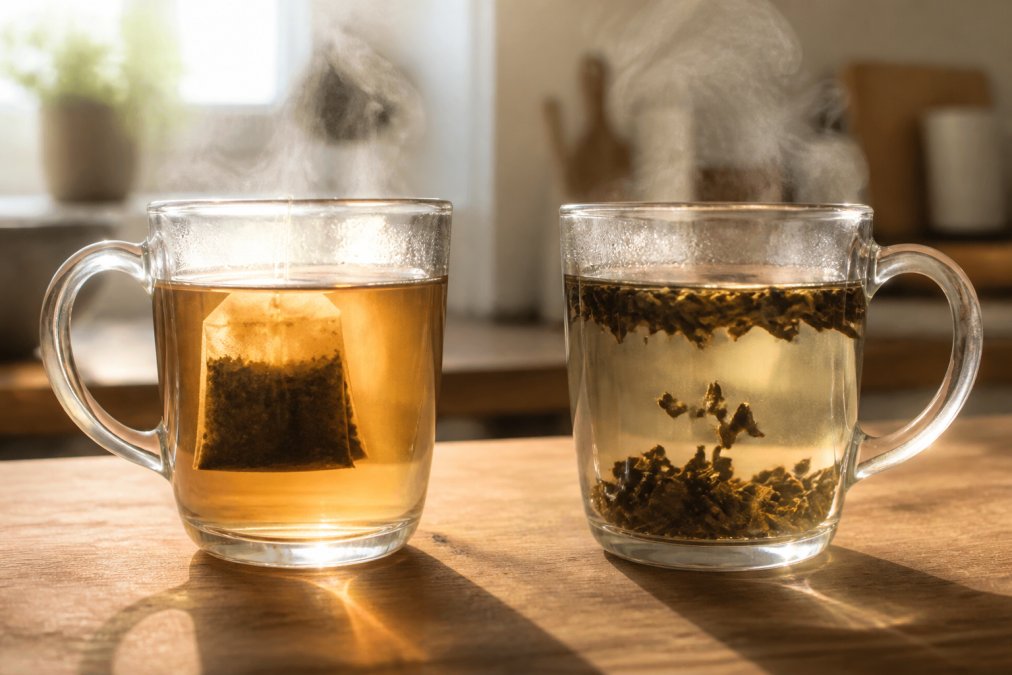
The mechanism behind the difference is surface area. A teaspoon of fannings exposes many times more leaf surface to water than a teaspoon of whole leaf. More surface means faster extraction of everything water-soluble, including the tannins and catechins that turn astringent when they over-extract. A tea bag can hit peak flavor in 60-90 seconds and then start degrading. Whole leaf releases its compounds over three to five minutes, which gives you a wider window before bitterness takes over.
Caffeine follows the same extraction curve. Because caffeine is highly water-soluble, small particles release it almost immediately. A tea bag can deliver most of its caffeine within the first minute or two. Loose leaf releases caffeine more gradually, which many drinkers find gives a smoother lift rather than a spike. The total caffeine in the cup depends on the tea type and how much leaf you use, a whole-leaf black tea brewed strong can easily exceed a standard bag, but the rate of release is where the formats diverge.
Antioxidants and polyphenols behave the same way. Whole leaves keep more of these compounds intact through processing, and a gentler steep preserves them in the cup. Oxidation levels, which determine whether a tea lands as green, oolong, or black, also read more clearly in whole leaf form because the leaf's intact structure holds the oxidation story, the color, the aroma, the way it changes across multiple steeps.
What most guides miss: the difference isn't just strength. It's flavor profile complexity.
Tea Bag Material Health Concerns: Microplastics and What to Avoid
Tea bag material health concerns center on one issue: some bags are sealed with plastic, not just paper. Many conventional bags use polypropylene to heat-seal the edges. When that bag hits boiling water, tiny plastic particles can shed into your cup.
What to avoid:
- Plastic mesh bags (the silky, see-through kind)
- Bags with a glossy, heat-sealed edge
- Unlabeled "biodegradable" claims without certification
Better options:
- Unbleached paper bags with no plastic seal
- Compostable bags certified to a recognized standard
- Loose leaf, which skips the bag entirely
Loose Leaf Tea Brewing Time and Water Temperature Explained
Loose leaf tea brewing time depends on the tea type, not personal preference. Get the water temperature and steep time right and the leaf does the rest. Get them wrong and even great tea turns bitter or flat.
Here's the baseline:
| Tea Type | Water Temperature | Steep Time |
|---|---|---|
| Green | 70-80°C | 2-3 minutes |
| White | 75-85°C | 3-4 minutes |
| Oolong | 85-90°C | 3-5 minutes |
| Black | 90-95°C | 3-5 minutes |
| Herbal | 95-100°C | 5-7 minutes |
How to Brew Loose Leaf Tea Without an Infuser
You don't need special gear to brew loose leaf. How to brew loose leaf tea without an infuser comes down to three workable methods, each using what's already in your kitchen. The equipment barrier to entry is smaller than most people assume.
Method 1: The two-cup pour
- Add one teaspoon of leaves to a mug
- Pour hot water and steep per the table above
- Pour the tea through a fine kitchen sieve into a second mug
- Drink, then compost the leaves
Method 2: The French press
- Add leaves to the bottom of a clean press
- Pour water, steep, then press the plunger slowly
- Pour immediately so the leaf stops steeping
Method 3: The teapot and strainer
- Add leaves to the pot, not a basket
- Steep, then pour through a small handheld strainer
Cost Per Cup and Sustainability: Which Choice Adds Up?
Cost-effectiveness often flips in loose leaf's favor once you do the math, but the math is more interesting than most guides admit. A bag is cheap per unit, but whole leaves can be resteeped two or three times. That spreads the cost across more cups than a single-use bag ever can.
- Packaging: one tin or pouch versus a box of individually wrapped bags. Individually wrapped bags often use a paper envelope, a plastic inner wrapper, and a string-and-tag assembly, three materials per cup.
- Waste: spent leaves compost; plastic-sealed bags often don't. Even 'biodegradable' bags may leave a polypropylene seal behind.
- Shipping weight: loose leaf packs denser, so less packaging per cup. A 100-gram pouch of loose leaf ships in a fraction of the volume of the equivalent number of bagged cups.
- Production energy: industrial tea bag production runs cutting, sifting, and sealing lines that whole-leaf processing skips. The difference is real, though it's hard to quantify without brand-specific data.
Frequently Asked Questions
Is loose leaf tea actually healthier than tea bags?
Loose leaf tea generally retains more of the leaf's natural compounds because whole leaves have less surface area exposed to air during storage, which slows oxidation and preserves antioxidants like polyphenols. Tea bags made from fannings and dust expose more surface area, so flavor and beneficial compounds fade faster. That said, both deliver antioxidants. The bigger health difference comes from the bag material itself: some synthetic mesh bags may shed microplastics during steeping, while paper and plant-based bags do not.
What tea bags should I avoid?
Watch for bags made from nylon, PET, or other plastic mesh, which are common in pyramid-style and silken bags. These can release microplastics into hot water. Also avoid bags where the leaves are fine dust rather than visible pieces, since dust loses aroma and flavor quickly. Look for bags labeled biodegradable, compostable, or made from paper, and check whether the string and tag are plastic-free too. If the material is not stated, treat it as a question mark.
What are the disadvantages of loose leaf tea?
Loose leaf tea needs more equipment and attention. You will want an infuser, a brewing vessel, or a French press, plus a way to strain leaves without making a mess. Steeping takes a bit more timing since there is no bag to lift out, and loose leaves can be messier to clean up. It also costs more upfront per package, though the cost per cup often works out lower because whole leaves can be resteeped two or three times.
Does loose leaf tea have more caffeine than tea bags?
Caffeine content depends on the tea type and how much leaf you use, not on whether it comes in a bag. Loose leaf tea often delivers more caffeine per cup simply because you use more leaf and get a fuller extraction. A standard tea bag holds around 2 grams of tea, while a loose leaf serving is often 2.5 to 3 grams. If caffeine matters to you, check the tea type first: black and matcha run highest, green sits in the middle, and white or herbal blends are lowest.